

Forget your mortgage rate? Not so fast.
There’s a pitch making the rounds in my industry: “Forget your mortgage rate. Look at your life rate.”
The idea is simple. Maybe your mortgage is at 3%. But you’ve also got a car loan at 9% and credit cards at 22%. Add it all up, and your real cost of borrowing is a lot higher than 3%.
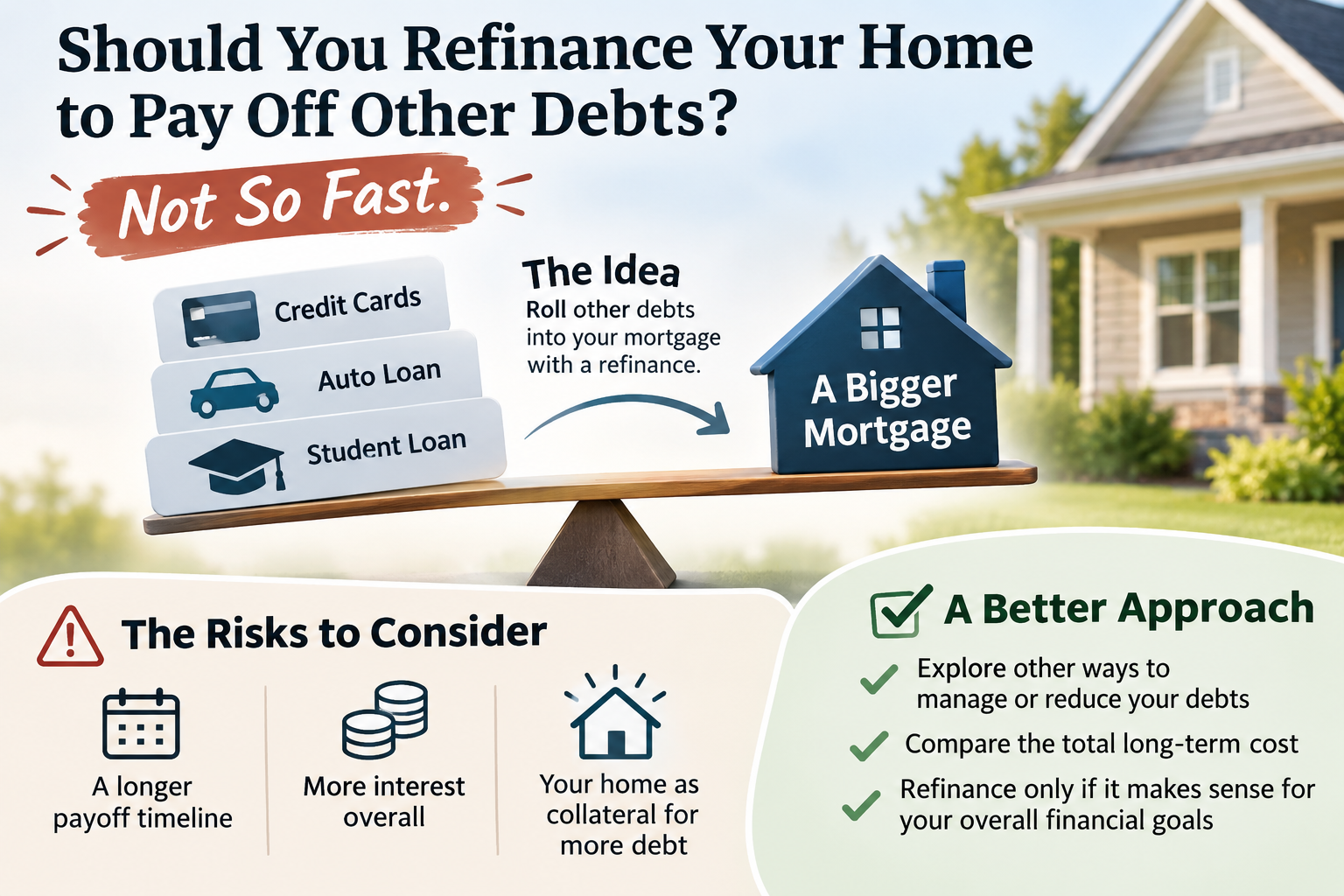
So the advice goes: do a cash-out refinance, roll the cards and the car into one new mortgage, and enjoy a single, lower monthly payment. There’s a version for buyers, too: sell your house, use the equity to wipe out the debt, and buy the next one.
The monthly payment usually does go down. That part is true. It’s just not the part that matters most.
A quick disclosure before we get into it. I’m a real estate broker and a mortgage broker. If you take this advice, I can get paid twice: once on the refinance and again when you sell. So when I say this pitch has a math problem, I’m arguing against my own paycheck.
The math at today’s rates
Let’s use a hypothetical household. They owe $350,000 on a 3% mortgage, $40,000 in credit cards at 22%, and $30,000 on a car loan at 9%. They’re considering a cash-out refinance at 7.25% for 30 years.
| Today | Cash-out refi at 7.25% | |
|---|---|---|
| Mortgage | $350,000 at 3% — $1,771/mo | |
| Credit cards | $40,000 at 22% — $1,100/mo | |
| Car loan | $30,000 at 9% — $623/mo | |
| Total owed | $420,000 | $420,000 |
| Monthly payment | $3,494 | $2,865 |
| Average interest rate | about 5.2% | 7.25% |
The payment drops by about $630 a month. That’s the number you’ll see in the ad.
Now look at the bottom row. The household’s average cost of debt went up, from about 5.2% to 7.25%. To fix $70,000 of expensive debt, they repriced $350,000 of the cheapest money they’ll ever borrow. That’s like selling your house because the gutters need cleaning.
The fair comparison: same budget, both ways
Say this family can afford the $3,494 they pay today, and they keep paying it no matter which path they choose.
| Path | Monthly | Debt-free in | Total interest |
|---|---|---|---|
| Keep the 3% mortgage, pay off the cards and car | $3,494 | about 13 years | about $118,000 |
| Cash-out refi, keep paying $3,494 | $3,494 | about 18 years | about $331,000 |
| Cash-out refi, pay only the new minimum | $2,865 | 30 years | about $611,000 |
Same family, same paycheck, same discipline. The refinance costs them about five extra years and roughly $213,000 more in interest. That’s before closing costs.
And if they only pay the new minimum? Close to half a million dollars more than the first path. That lower payment isn’t savings. It’s a layaway plan.
The debt that follows you from house to house
Here’s the part almost nobody talks about.
Most people never make the last payment on a 30-year mortgage. They sell or refinance long before year 30. So when you roll a car loan into your mortgage, it stops getting paid off on its own schedule. It gets paid off at closing, out of your equity, whenever you sell.
Then you buy the next house with a new mortgage. By then there’s probably a new car, maybe some new card balances, and a decent chance that debt gets rolled in too.
Fast-forward a decade. You could be paying for a Honda you sold years ago, a vacation you barely remember, and a couch that’s long since been put on the curb. All of it sitting inside your mortgage, quietly eating your equity.
Your mortgage becomes a storage unit for old debt. You keep paying rent on stuff you don’t own anymore.
Two more risks: your house and your habits
Your house becomes the collateral. Credit card debt is unsecured. If things go sideways, you get damaged credit and collection calls. That’s miserable, but you keep your home. Once that debt is inside your mortgage, it’s secured by your house. You’ve turned a debt that could cost you your credit score into one that could cost you your kitchen.
The cards don’t stay empty on their own. Consolidation clears the balances. It doesn’t clear the habits that created them. Plenty of people refinance, feel great, and find the cards full again a couple of years later. Now they have the cards and the bigger mortgage. If the spending hasn’t changed, a refinance doesn’t fix the problem. It reloads it.
When rolling debt into your mortgage does make sense
This isn’t always the wrong move. Here’s when the life rate idea can hold up:
- You don’t have a low rate to protect. If you bought in 2023 or later and you’re already near today’s rates, consolidating doesn’t give up much. The math changes completely.
- You’re about to miss payments. If your cards are heading toward default, cash flow matters more than total interest. A lower payment that keeps you current beats a cheaper plan you can’t keep up with.
- You’re moving anyway and need to qualify. Paying off debt with sale proceeds can lower your debt-to-income ratio enough to get approved for the next home. Just know the trade: a smaller down payment means a bigger loan at today’s rates.
- You’ll keep paying the old amount. If you refinance but keep sending what you paid before, you limit the damage. It still costs more than keeping the low rate, but you won’t be paying for today’s car in 2056.
The option most people skip: a second loan
If you have equity and a great first mortgage, protect the first mortgage. Leave the low rate alone and borrow against your equity with a second loan instead: a fixed-rate home equity loan or a HELOC.
| Option | Monthly payment | What happens to the 3% |
|---|---|---|
| Cash-out refi: $420,000 at 7.25% for 30 years | $2,865 | Gone |
| Keep the 3% + $70,000 home equity loan at 8.5% for 10 years | $1,771 + $868 = $2,639 | Kept |
Here’s what surprises people. The second loan carries a higher rate than the refinance, and the total payment still comes out lower. That’s because you pay the higher rate on $70,000, not the refinance rate on everything. And the debt is gone in 10 years instead of 30.
The same caution applies: it’s still secured by your home, and it only works if the cards stay paid off.
No equity, or don’t want to touch it? Go the old-fashioned route. Pay down the highest-rate card first, consider a 0% balance transfer if your credit allows, and leave your house out of it.
The bottom line
Looking at all your debt together is smart. The life rate idea gets that part right.
But “my payment went down” and “I saved money” are two different sentences, and the pitch counts on you hearing them as one. Before you refinance a great rate to fix a bad one, compare both paths: total interest, years until you’re debt-free, and how much equity you’ll have left when you sell.
If the refinance still wins, do it with your eyes open.
Want to see both paths with your own numbers? Reach out at dan@urbanmaple.com or 503-381-5161. I’ll show you the version where I don’t get paid, too.
For a look at today’s rates: approvedbydan.com
Dan Walters · Principal Broker, RE/MAX Equity Group · Mortgage Broker, Morty, Inc. · NMLS #2721869. All figures are hypothetical and for illustration only. This is not a commitment to lend or an offer of credit. Rates, payments, and terms vary by borrower and market conditions. Equal Housing Opportunity.
Frequently Asked Questions
Not necessarily. There are times they might make sense. But the bar should be higher than simply "it reduces my payment."
Maybe. Sometimes doing so will let you get a better loan. Bear in mind, though, that money you use to pay off other debts is no longer available for down payment, which means you'll borrow more. Handle this on a case-by-case basis.